
soldering involved in PCB fabrication assembly
Soldering is a critical process in PCB (Printed Circuit Board) fabrication assembly, serving as the primary method for electrically connecting components to the board. The soldering process ensures that electronic components are securely attached and their electrical pathways are properly established, which is essential for the functionality and reliability of the final product. In the context of PCB fabrication assembly, soldering is not just a simple attachment process; it requires precision, expertise, and attention to detail to avoid defects that can lead to component failure or poor performance.
In pcb fabrication assembly, the primary function of soldering is to create strong, conductive joints between the component leads and the copper traces on the PCB. These connections allow electrical signals to flow between components, forming the necessary circuits for the device to function. The most common method of soldering in PCB assembly is called “wave soldering” or “reflow soldering,” although manual soldering is also employed in certain situations.
Wave soldering is a process typically used for assembling through-hole components, where the PCB is passed over a wave of molten solder. The molten solder adheres to the component leads and the copper pads on the PCB, creating the necessary electrical connections. This method is highly effective for mass production as it can quickly solder a large number of joints simultaneously. The wave soldering process is often used in combination with automated PCB fabrication assembly lines, which enhance speed and consistency.
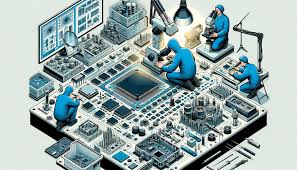
How is soldering involved in PCB fabrication assembly?
Reflow soldering, on the other hand, is commonly used for surface mount devices (SMDs). In this process, solder paste—composed of tiny solder balls suspended in flux—is applied to the PCB’s solder pads. Components are then placed on the PCB, and the board is heated in a reflow oven. The heat causes the solder paste to melt, forming a solder joint between the component leads and the PCB. Reflow soldering is precise, as it allows for the soldering of delicate components and fine-pitch connections, which are typical in modern electronics. This method is crucial for ensuring high-density PCBs where space is at a premium.
Manual soldering is often used for components that are difficult to solder using automated processes, or in low-volume production. In this process, a soldering iron is used to heat the component leads and the PCB pads, allowing solder to flow and form a connection. Manual soldering is essential when dealing with fine-pitch components, repair work, or custom modifications to a PCB. While manual soldering is labor-intensive and slower than automated methods, it is still a vital part of PCB fabrication assembly, especially in prototyping or small-scale production runs.
The quality of solder joints is critical in PCB fabrication assembly. Poor soldering can result in a range of issues, including cold joints, which can lead to poor electrical connections, or solder bridges, where excess solder causes unintended short circuits between adjacent pads. Other defects such as cracked solder joints or insufficient soldering can lead to component failure, signal integrity issues, or reliability concerns. Therefore, proper temperature control, soldering technique, and inspection are essential to ensure that each joint is clean, uniform, and electrically sound.
In PCB fabrication assembly, automatic inspection methods like Automated Optical Inspection (AOI) are often used to inspect solder joints for defects. These systems use cameras and software to visually scan the board and identify issues like missing solder, misalignment, or excessive solder. X-ray inspection is also utilized for detecting hidden solder defects, such as those under components in a multi-layer PCB. Ensuring that the soldering process is carefully monitored and controlled is crucial to maintaining the integrity of the PCB and preventing defects that could impact the final product’s performance.
During the soldering process, heat plays a crucial role, but excessive heat can damage sensitive components. For instance, components like semiconductors or LEDs can be damaged by prolonged exposure to high temperatures. This is why thermal management during soldering is essential. PCB fabrication assembly requires precise temperature control, and processes like reflow soldering are specifically designed to minimize the risk of overheating while ensuring that solder flows correctly and forms reliable joints. Manufacturers must use soldering equipment capable of providing uniform heating to prevent localized temperature spikes that could cause damage.
Soldering is an integral part of PCB fabrication assembly, serving as the process through which components are electrically and mechanically connected to the board. Whether using automated techniques like wave soldering or reflow soldering, or employing manual soldering for specific tasks, the soldering process requires precision and care to ensure high-quality results. The effectiveness of the soldering process directly impacts the overall performance, reliability, and longevity of the final product. By maintaining proper soldering techniques and using advanced inspection methods, manufacturers can ensure that the PCB fabrication assembly process meets the necessary standards and delivers functional and durable PCBs.


